|
What Does the U.S. Constitution Actually Say About Religion?
We have heard, for years now, how there is a "wall of separation" or "separation of church and state" between the government and religion, and how also the government, or even individuals in the https://florafox.com/ca/winnipeg-15923 are forbidden from "endorsing" a particular religion. Is that true?
Let's a take a look at what the Constitution of the United States actually says about religion.
If you were to search the constitution for the word "religion", you will find that it appears only once. In fact, it doesn't actually appear in the constitution proper, but is located in the First Amendment.
Keep in mind, as you read this article, that the first ten amendments or "Bill of Rights" was described by the founding fathers as:
"The Conventions of a number of the States, having at the time of their adopting the Constitution, expressed a desire, in order to prevent misconstruction or abuse of its powers, that further declaratory and restrictive clauses should be added".
Pay particular attention to the phrase "to prevent misconstruction or abuse of its (the governments) powers".
Here is what the First Amendment says:
"Congress shall make no law respecting an establishment of religion, or prohibiting the free exercise thereof; or abridging the freedom of speech, or of the press; or the right of the people peaceably to assemble, and to petition the government for a redress of grievances."
So in the First Amendment, the founding fathers clarified "freedom of religion", "freedom of speech", "freedom of the press", "freedom of peaceful assembly" and the right "to petition the government for a redress of grievances".
Since this article is about religion, let's take the first portion "Congress shall make no law respecting an establishment of religion, or prohibiting the free exercise thereof".
What exactly are they trying to say here?
One key word that both opponents and proponents throw at each other is "establishment". Some within the legal system go as far as to call the First Amendment "the establishment clause".
The Merriam-Webster dictionary defines the word "establishment" as:
"Something established : as a : a settled arrangement; especially : a code of laws".(1)
From this we derive the word "Established" which is further defined as:
"To institute (as a law) permanently by enactment or agreement".(2)
So put back in context, Congress cannot establish a national religion.
Let's go on.
"…or prohibiting the free exercise thereof".
Again, let's turn to the Merriam-Webster dictionary for a definition of the word "prohibiting":
"To forbid by authority" and "to prevent from doing something".(3)
Okay, so the key concepts here are:
1. The government will NOT establish a national, government run religion.
2. The government CANNOT prevent a person from exercising their religious beliefs.
"But wait", you say. "What about the 'separation of church and state'"?
Remember that I said that the only place that the word "religion" appears in the Constitution is in the First Amendment and also, the word "church" never appears in the Constitution.
So where does this statement, "separation of church and state", come from?
In October of 1801, the Danbury Baptist Association of Connecticut wrote a letter to President Thomas Jefferson, expressing the fear that the United States government was going to establish the Congregationalist Church as the official denomination of the new nation. This would be similar to what the King of England had done in establishing the Church of England as the official state religion there.
It was their view that in Connecticut, religious liberties were not seen as rights, but as privileges granted by the legislature - as "favors granted".(4)
In his response to them, President Jefferson eluded to "a wall of separation between church and state", stating in whole:
"Believing with you that religion is a matter which lies solely between man & his god, that he owes account to none other for his faith or his worship, that the legitimate powers of government reach actions only, and not opinions, I contemplate with sovereign reverence that act of the whole American people which declared that their legislature should make no law respecting an establishment of religion, or prohibiting the free exercise thereof, thus building a wall of separation between church and state. [Congress thus inhibited from acts respecting religion, and the Executive authorised only to execute their acts, I have refrained from presenting even occasional performances of devotion presented indeed legally where an Executive is the legal head of a national church, but subject here, as religious exercises only to the voluntary regulations and discipline of each respective sect.] Adhering to this expression of the supreme will of the nation in behalf of the rights of conscience, I shall see with sincere satisfaction the progress of those sentiments which tend to restore to man all his natural rights, convinced he has no natural right in opposition to his social duties."
The bracketed section was marked for deletion, but was left in President Jefferson's first draft and is included here for completeness (emphasis added by me).
Using the words "wall of separation between church and state", President Jefferson appears to be telling the Danbury Baptist that the government would not relegate them to the "secondary status" they were worried about. In other words, the Federal Government would "make no law respecting an establishment of (a national) religion" and exclude all others as fringe, possibly even outlawing them (as the King of England had done).
But wait a minute. Most people are under the impression that the "wall" is to protect the government from the church, not visa-versa as President Jefferson and the Founding Fathers intended. So how did this "wall" idea get flipped around?
In 1947, Supreme Court Justice Hugo Black, commenting for the majority in Everson v. Board of Education, said:
"The 'establishment of religion' clause of the First Amendment means at least this: Neither a state nor the Federal Government can set up a church. Neither can pass laws which aid one religion, aid all religions, or prefer one religion over another. Neither can force nor influence a person to go to or to remain away from church against his will or force him to profess a belief or disbelief in any religion. No person can be punished for entertaining or professing religious beliefs or disbeliefs, for church attendance or non-attendance. No tax in any amount, large or small, can be levied to support any religious activities or institutions, whatever they may be called, or whatever form they may adopt to teach or practice religion. Neither a state nor the Federal Government can, openly or secretly, participate in the affairs of any religious organizations or groups and vice versa. In the words of Jefferson, the clause against establishment of religion by law was intended to erect 'a wall of separation between church and State.'"(5)
From Justice Black's comments, we can see that now the "wall" has been moved to place "protection" between the church and both federal and state governments (see the graphic below). Also from this ruling, Justice Black ADDS that laws cannot aid religions and that taxes cannot be used to "support religious activities or institutions".
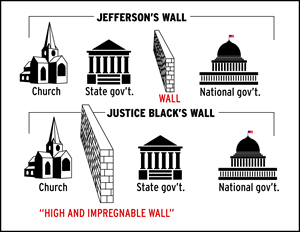
So, in 1947, the relatively simple First Amendment, whose purpose was to protect religion from government interference, has been "interpreted" to mean almost exactly the opposite! Now, according to Justice Black and the "majority" on the Supreme Court, government must be protected from religion, a view that is contrary to what the First Amendment declares and to what the Founding Fathers intended.
It almost seems as though the second part of the First Amendment's "religion clause" is completely ignored by the current judicial system.
"...prohibiting the free exercise thereof"
Now based on what this statement says, the government cannot prohibit a person from professing their faith, praying or speaking about God, in either a public or private forum.
Yet hardly a day goes by when someone is not being sued by the ACLU (American Civil Liberties Union) or some other organization, for professing their faith in a public, sometime government, setting. According to the First Amendment, professing one's faith anywhere is in no way illegal. So how is it that children can no longer pray in school? How can it be that teachers cannot keep their Bibles on their desk or have inspirational sayings, based on the Bible, on the walls?
Thankfully, the courts have not yet ruled that Congress and Supreme Court sessions cannot be opened by prayer. Yet in our schools, God has been banned. Let's look at this further.
Many court cases that established a precedent of banning communal prayer time, and forbidding the mere mention of God in any form, have used the so-called "establishment clause" to argue their positions. Let's look at the First Amendment once again:
"Congress shall make no law respecting an establishment of religion…"
So I would ask, when did schools get the power to pass laws, thereby establishing a national religion? I thought the right to pass laws was a right reserved for the legislature and president. Well, it is. Schools cannot make laws, and therefore cannot establish a national religion.
When a school prohibits a child's right to express his/her religion, isn't this actually against the First Amendment? If the First Amendment is read as it is written and not liberally "interpreted", yes, this should be illegal. Yet the courts of the land have liberally interpreted the First Amendment, and from legal precedence, have told the country, the congress, the president, and even the Founding Fathers that it doesn't matter what the First Amendment really means.
An interesting quote can best be used to preface this next point:
"(Concerning the ACLU), they see the separation of church and state as so absolute that not a single religious word must be allowed to pass a schoolhouse door" (Nat Hentoff, former ACLU board member and atheist).(6)
"Not a single word" is how Mr. Hentoff worded it.
So in the days of our Founding Fathers, religion was protected from the government. No one came under fire for praying in school, or reading their Bible or even speaking about God. Now in these days of "enlightened" society, we have activist judges who believe that they can change laws they don't like by "interpreting" them.
"Congress shall make no law respecting an establishment of religion, or prohibiting the free exercise thereof". What part of this needs to be interpreted? It's very plainly written.
Speaking of the ACLU, they would like everyone to believe that they are for personal liberties and are here to stand up for our right to worship.
And yet in May of 2000, then Arizona Governor Jane Hull issued a proclamation celebrating the birth of Buddha. An ACLU spokesperson said, "Although we may think proclamations are inappropriate, they may not violate the Constitution." But earlier in 1998, when Governor Hull issued a proclamation declaring a "Bible Week," the ACLU sued, claiming a violation of the so-called "separation of church and state."(7) Ah, so it's just Christians that the ACLU has problems with, not all religions.
"Congress shall make no law respecting an establishment of religion, or prohibiting the free exercise thereof".
Very plainly written. Very straight to the point and not in need of any "interpretation".
It takes someone with a very anti-Christian agenda to read any other meaning into this amendment. The Founding Fathers understood it. The Presidents and Congresses over the ages have understood it. Until the 1940's the Supreme Court understood it. It takes an activist judge to find any other meaning.
God Bless!
-Steve
Jesus is Lord, A Worshipping Christian Family Web Site
References:
1. Merriam-Webster, "establishment"
2. Merriam-Webster, "established"
3. Merriam-Webster, "prohibiting"
4. Jefferson's Wall of Separation Letter, The U.S. Constitution Online, copyright 1995-2006 by Steve Mount
5. Wikipedia, "Everson v. Board of Education
6. Jesus is Lord, Blog, "Interesting Quotes"
7. The ACLU, Decades of Shame, copyright 2001 Coral Ridge Ministries
 |